In my last post, a rather long time ago, I posited something along the lines of how the ongoing existence of the human race is something that might not be accomplished on this planet, but on some other yet-to-be-explored planet whose exploration will, hopefully, be enabled by technology one day. So, you can imagine how excited I was to watch Interstellar. This is a non-spoiler post. The fricking tagline is, "Mankind was born on earth. It was never meant to die here."
And in truth, while I am obviously no expert in the science and technology required for the exploration of the stars, I loved that the movie was trying to take this idea further. The movie attempts to be thematic, like most of Christopher Nolan's movies, but perhaps more subtlety would be in order. That said, even if it does beat the idea of exploration into your head, if you haven't yet wondered about the future of humanity in the universe after watching this movie, I think it's a thought experiment worth considering.
We always say stuff like, "It really makes you feel so small in the grand scheme of things" or, "We're just specks of dust in the universe." Yes, they are both entirely true. But that's what makes it exciting, no? A 99.9999% unexplored thing is way more intriguing and exciting than a 99.9999% explored thing. It's at times like these I wished I was an astronomer professionally; to make it my life's work or, my undying love, to explore the stars. Right now, all I am is this 'dabbler':-
I should admit that, yes, right now, I just think space is pretty. But I do wonder - and perhaps it's one of the key counterfactuals of my life - what would have been had I chosen astronomy for a field instead. It's just too bad you can't choose both roads.
On a related note, so some people look at the stars and they think, "I wonder what the Big Bang was like." Some others look at the same stars and they think, "Praise the Glory of God Almighty." Let me be clear - I am an atheist, as I've said many times. I'm not a belligerent atheist, I'm just an atheist. An agnostic one at that. Although, in fairness, I am belligerent about the use of the word 'agnostic.' And, really, I do get why people believe in religion and a higher deity and I do recognize the value of religion. In fact, I would venture to suggest that I am uncomfortable with the idea of a secular government insofar as I believe the notion that policy should not be influenced by 'religion' to be false. The simple reason for this is that if the people care about religion, then policy should incorporate what these people care about. Yes, it needs to be tempered by the non-religious bunch of people, but I think it is a valid concern in the policy space that requires addressing.
That said, it is unlikely that I will ever believe in a God or some higher deity. Personally, if I were to believe in an all-powerful being, I'd go with Zeus. Homeboy has lightning bolts. But, some of the concepts from Christianity are just so goddamn beautiful that it's hard to, sometimes, just fall on your knees for 'redeeming grace.'
You see, I get a kick out of Christmas songs, both the religious and the non-religious stuff. Stuff like Silent Night really moves me. Not so much because I believe in Jesus Christ and all that stuff, but because the power of faith and belief in people is just so strong. I have all the respect in the world for people whose faith in whatever they believe is so strong. I mean, they are staking their whole lives and culture on something that can never be proven to exist. How does that work? I suppose it's the same for most scientific studies - the Big Bang Theory, String Theory etc - but the amount of faith just blows me away.
I think it's good to have Faith. Faith requires the ability to believe in something larger than yourself which, I think, is always a good thing. It could be some abstract value, it could be a God, it could be a community, whatever. Faith is a good thing. And Christianity is (obviously) all about faith.
It is also about Grace. Amazing Grace is one of the most beautiful songs ever written and I agree with the main message - T'was Grace that brought us safe thus far, and Grace will lead us home.
I mean, how beautiful are those two lines? Sure, the song means God's Grace. But if we think of Grace as something else, which is just kindness to our fellow people, I think it encapsulates exactly how we all should treat each other. With Kindness. With Forgiveness. With Grace.
It is often true that we shouldn't judge a book by its cover, and that we shouldn't judge people just by first impressions. The problem is the same people who say that are also the same people who say that first impressions matter. But, of course, first impressions don't matter to them, just to other people (if you didn't get the snark from that sentence, carry on). I am often chided by people I know for judging others too quickly (despite the idea that first impressions matter, y'know) and, to some people, I am the most judgmental person they know.
I would like to offer a counter-perspective. First, let me both offend and defend those who say we shouldn't judge people by their first impressions but simultaneously suggest that first impressions matter. To defend, you are not completely wrong. To offend, you just haven't thought it through enough. I think I can put forward a way to think about this that makes sense and does not make you (or me) a hypocrite. In other words, I'm doing your thinking for you. If that sentence sounded super obnoxious, please note that it was happily laced with snark and thus, meant to be super obnoxious.
Just to lay my cards on the table, part of my opinion on a person, or a matter, is shaped by my first impressions or observations of them. So, yes, by the definition of most, I do 'judge' people by their covers. If someone says something stupid, my initial opinion is formed, based on that observation. However, the key difference between my definition of 'judge' and the common definition of 'judge' is that all I'm doing is making a hypothesis. This, I think is using the Scientific Method to evaluate people.
The Scientific Method to People is based on three foundations. The first is the Scientific Method (duh). The second is the concept of Bayesian Priors. The third is the aggregate baseline. I will go through each in step.
Step 1 - The Scientific Method
This is essentially treating each individual as a potential experiment. I first observe them when I first meet them. Based on those observations, I make a hypothesis about them. A hypothesis is essentially something to test; it is very different from a conclusion which is ex-post. From that hypothesis, if I have more interactions with these individuals, I therefore update my hypothesis based on the new data and information that I get from 'experiment.' At some point, you hit a diminishing marginal returns of new knowledge segment when meeting a given individual. (For example, you are much less likely to find out something surprising about someone you've known closely for 10 years than you are someone who you've known for just 2 weeks). When the curve essentially becomes relatively flat, then you can make a conclusion.
Look, for everyone we know, we do make "judgments." But it's important to know which ones are hypotheses and which ones are conclusions. It applies to everyone - friends, romantic partners, FWBs, colleagues, affiliates etc. The more you meet them, the more 'experiments' you conduct on them. For some, you'd rather stop after the first 'experiment'. For others, you want to undertake more 'experiments'. The Scientific Method is all about experimenting and figuring out what the data tells you. What the data tells you should be your conclusion. But, how do you know how many experiments to run? What is the requisite number? The way, I think, to answer that question is through the Bayesian Priors.
Step 2 - The Bayesian Priors
To evaluate the probability of a hypothesis (in other words, whether your hypothesis works), the Bayesian probabilist specifies some prior probability, which is then updated in the light of new, relevant data. Essentially, one updates the probability estimate for a hypothesis as new information gets received. What this says, for the purposes of the Scientific Method to People, is that it's totally fine to make hypotheses about people (A given person is likely kind, stupid, stingy, immature, brave, optimistic etc etc) as long as you are willing to allow your hypotheses to be changed as data from experiment leads you in different paths. You cannot be too hooked onto your hypotheses such that you are unwilling to change them. Precept 4 of Prospero's Precepts says that one should never fall in love with one's hypothesis.
So, it's okay to make evaluations of people based on your observations. Everybody does that (for the record, judging doesn't always imply negative judgment. Judging that someone is smart is also judging). But you should always be ready to change them. Not everybody does that. So, update your priors as you go along.
So, we have established that a) Make hypotheses, run experiments and then make conclusions and b) As you run experiments, be ready to update your priors and thus, your hypotheses, based on new data. Now, how do we form hypotheses? What would be an objective way of forming a hypothesis? For this, we need the aggregate baseline.
Step 3 - The Aggregate Baseline
Consider this quote from Sherlock Holmes in "The Sign of the Four." He says, "...While the individual man is an insoluble puzzle, in the aggregate he becomes a mathematical certainty. You can, for example, never foretell what anyone man will do, but you can say with precision what an average number will be up to. Individuals vary, but percentages remain constant. So says the statistician." Sherlock Holmes is essentially describing the Law of Large Numbers, a statistical concept which posits that if the sample size is large enough (i.e. you've performed the experiment often enough), the mean of the experiment will be the expected value.
Let's take an example. Consider the toss of a fair coin. The probability of heads or tails is 0.5. Now, if you toss a given coin, you don't know whether it'll be heads or tails. You just know that it's a 50-50 chance for either. So, the individual toss is unpredictable. If you toss it 10 times in a row, you could still get 10 Heads or 10 Tails, based solely on complete randomness. Consider the following sequences of tosses:-
1. H H H H H H H H H H
2. T T T T T T T T T T
3. H T H T H T H T H T
4. H H H H H T T T T T
5. H H T H T T T H H T
6. T T H T T H H H T H
With a fair coin, the probability of each ot these 6 sequences is exactly the same - 1/2 to the power of 10. While 5. and 6. may seem like the most 'random', 1, 2, 3 and 4 are equally likely as well (please see the end of this blog post for a note about intelligent design). The Law of Large Numbers, and Sherlock Holmes, says that if you do things at a large enough level, you should get your expected probability which, in this case, is 1/2. So, for a large enough sample, you should expect Heads to show up 50% of the time and Tails to show up 50% of the time, even if this is not what it ends up being.
AND SO, with people, it's the same. I find it acceptable to use stereotypes (the aggregate baseline), even if they are politically incorrect stereotypes, as a way of forming my initial Bayesian priors of people. But that in no way means that I conclude that about a person, and thus, do not change my mind. For example, if I see someone who spends a lot of time in the library, I'm likely to think that she (assuming she's a girl) is the love of my life a studious person. And that would fit the stereotype aggregate. And that's how I form my hypothesis. As I go on dates with her interact with her more, I update my priors to the 'individual' level. Maybe she's not the love of my life studious. Maybe she only spends a lot of time in the library for a reason other than something studious. And that's fine. That's how I update my priors based on new data, and that's how I form a conclusion. I just must not fall in love with my hypothesis.
So, how many experiments to run? I actually would argue that you can never really make a conclusion and that everybody is just an ongoing 'experiment'. I think that's fair - you may not have to experiment more, you can prioritize some 'experiments' over others. But that still leads back to the same problem - how do you choose who you want to get to know better and who you don't? Again, it's the aggregate. Most people tend to fit into particular types of stereotypes, and you can decide, for yourself, if you want to hang out with that type of person - party animal, nerd, jock, geek - while being, firstly, fully aware that a person may not be the stereotype you think, secondly, fully aware that a person may be more than one stereotype, thirdly, fully aware that you may be completely wrong and, fourthly and most importantly, you do not treat someone with less respect and less dignity just because they happen to fall into a certain type of stereotype, particularly arbitrary stereotypes. 'Arbitrary' stereotypes here mean stereotypes that people fall into by no means of their choices - race, ethnicity, sexual orientation, gender. It is acceptable and reasonable to not want to experiment further with someone who knowingly smokes (a smoker stereotype). It is completley unacceptable and unreasonable to not experiment further with someone just because they're Jewish or gay or male or whatever arbitrary attribute.
Therefore, feel free to stereotype people but keep in mind the four caveats I had earlier. You can use stereotypes to form your hypotheses but you should never use stereotypes to form conclusions. You can decide for yourself if you want to continue the experiment or conclude there and then, but I'd strongly recommend keeping all hypotheses open and allowing your Bayesian priors to be updated accordingly. All we can do is to just use the aggregate baseline as our priors, updating our priors as we go along, choosing the stereotypes that we want to get to know better. For example, I'd rather not hang out with someone who racially profiled people at our recent elections because I think that person is a racist. But, I'm open to the possibility that that person might not be racist (though I'm probably right). Yes, caveat - you can use the "I'm probably right" notion if you believe yourself to be a good judge of character. So, how do you choose how many experiments to run? Choose the stereotypes or aggregate baselines that you like and experiment more with those. You don't have to experiment more with the stereotypse you dislike, but keep in mind the caveats earlier.
Lastly, you know how in movies or books, the potential romantic partner goes, "I really like you. You're unlike everyone I ever met," or "I really like you; I can't figure you out and that excites me." It's really cliche but it's representative, actually, of everything I just typed. It's essentially someone updating their Bayesian priors about their interest and finding out that this person doesn't fit into the stereotype that the Bayesian thinker first conceived. And when you can't put that person into a given bucket, the person becomes intriguing. Like Precept 7 in Prospero's Precepts, "The thing that doesn't fit is the thing that is most interesting."
----
Quick note on countering the argument on intelligent design. Consider:-
1. H H H H H H H H H H
2. T T T T T T T T T T
3. H T H T H T H T H T
4. H H H H H T T T T T
5. H H T H T T T H H T
6. T T H T T H H H T H
If we flipped a coin a million times, getting a million 'H's is also possible, if supremely unlikely. But, you can still get it through sheer randomness. Just because it looks pre-ordained doesn't mean it is. It is equally as likley as any other sequence. If the coin had fallen another way, the outcome would be different, but the process is the same. This is why the intelligent design argument fails, in my opinion. Just because things are the way they are doesn't mean they were intelligently designed. The probability for things being the way they are are just as likely as the probability for things being another particular way. Remember, you cannot conclude what the individual will do, even if you can mathematically estimate what the aggregate will do.
I came across one of the best soundtracks in memory from the 2004 movie, In Good Company. The movie itself was solid. I liked it - nice feel-good movie without being overly corny. And, of course, it featured the lovely Scarlett Johansson.
Hoodies are the way to go.
Anyway, on the soundtrack. The soundtrack gave me the introduction to Iron and Wine - notably, Naked as We Came (interpret that how you will) and, more notably, The Trapeze Swinger. Listen to this in the dark. Don't think about anything else. Just soak in the song. Listen to the lyrics. It'll be worth it. Another song from that soundtrack is David Byrne's "Glass, Concrete and Stone." I hadn't thought of that song in a long time.
Tonight though, I was overlooking the skyline of some country at 10pm. And it was breathtaking. Whoever says that glass, concrete and stone (connection made!) lacks aesthetic qualities needs to have her or his head examined. I wish I could say I took a picture, but the Constant Reader knows how bad I am at all that. Anyway, city lights, when done right, are one of the world's best sights. Don't believe me? Fuck you. I have always loved the city lights on the water (snigger).
Anyway, beyond just the aesthetic of an amalgamation of concrete, glass and stone and lights, I thought also of Jay-Z's line in Empire State of Mind. Side note, I can rap the whole song without referring to lyrics. Just ask me. Anyway, the line goes, "8 Million Stories, out there in the naked." It's essentially what a city is, no? A dense agglomeration of people, all with their own stories, all with their own lives, hoping to achieve whatever it is they want to achieve, fighting every day (for most people at least) hoping just to make it through the week, hoping that one day their efforts will make the lives of their kids better. But like Jay-Z says, "It's a pity half of ya'll won't make it."
I cannot be fairly described as some paragon of humility, despite my best efforts, but I do believe what Jay-Z said, or rapped. In a city of 8 million people, there are 8 million stories. It felt rather peculiar looking down tonight at the city below, seeing the various lights from office buildings, homes, roads, cars whatever and thinking that each person contributing to those lights were living out their own story. Maybe they were rushing home to watch the latest Mad Men episode. Maybe they were taking on another shift as a cab driver to help put food on the table. Maybe they were trying to close a deal in some office. Maybe they had just reeturned from a date. I don't know. But it's quite humbling, I think. When you recall that in the grand scheme of 8 million people, one's life is just that. One. Out of 8 Million.
And the thing is, each of those 8 million stories is unique. Well, nearly all anyway (accounting for siblings who grew up in the same family, attended the same schools etc etc). I have never believed that just because you're unique, you're therefore special as I've made clear before. But that uniqueness is still something that is interesting. If each person is a story, which admittedly appeals to me from a poetic sense, then each unique story makes that person the only person in the world who has lived that tale. I think it's fair to say that hardly anybody is special, but everyone is unique. It's like the following two quotes from Watchmen (by Doc Manhattan):-
"Themodynamic miracles...events with odds against so astronomical they're effectively impossible, like oxygen spontaneously becoming gold. I long to observe such a thing. And yet, in each human coupling, a thousand million sperm vie for a single egg. Multiply those odds by countless generations, against the odds of your ancestors being alive; meeting; siring this precise son; that exact daughter...Until your mother loves a man she has every reason to hate, and of that union, of the thousand million children competing for fertilization, it was you, only you, that emerged. To distill so specific a form from that chaos of improbability, like turning air into gold...that is the crowning likelihood. The thermodynamic miracle."
"Yes, anybody in the world...But the world is so full of people, so crowded with these miracles that they become commonplace and we forget...I forget. We gaze continually at the world and it grows dull in our perceptions. Yet seen from another's vantage point, as if new, it may still take our breath away. Come...dry your eyes, for you are life, rarer than a quark and unpredictable beyond the dreams of Heisenberg. Come, dry your eyes. And let's go home."
I think cities remind us of stuff like that. A collection of stories, each one nearly entirely unique, coming together to try and make things work. It's humbling. Even the most reprehensible person has a story and even the most tame of people has a story. And that's life. And Doc Manhattan says we must remember that.
Speaking of life, may I interest you in a new scientific hypothesis - life began even before the Sun existed. The arguments make sense. Next comes the proof. But this is baller.
There are things in life that are easy to let go. And there are also, naturally, things in life that are not easy to let go. While Don Draper's quote - "Just get out of here and move forward. It never happened. It will shock you how much it never happened." - is great life advice for nearly every conceivable situation, there is still one particular thing that continues to bother me to this day. That particular thing is the ending of the Dark Knight Rises.
I wrote about this in an earlier review of the movie. But, I'm not through. And, yes, spoiler alert. But if you haven't watched the movie yet (it's been half a year), and you're going to be all, "Don't spoil it for me! I still want to watch it!", I have two responses. The first is that you probably don't care about it enough anyway, so it's no big deal. The second is, go screw yourself. Cheerful remonstrations aside, the reason I am returning to this issue is because I had a micro-mini-Eureka moment about 5 minutes ago juxtaposing why the LOTR ending worked so well and TDKR ending didn't.
Here's what I wrote about the ending of TDKR:-
"...I agree it covered up all loose ends and was a very neat ending to the Trilogy (more on this later). But to me, it's a bit too neat. At the end of the movie, Bane was defeated. Talia Al'Ghul was defeated. Gotham was saved. Lucius Fox got what he wanted. Alfred got what he wanted. John Blake got what he wanted. James Gordon got what he wanted. Bruce Wayne got what he wanted. Hell, even Selina Kyle got what she wanted. But how likely is this? In a world where I can suspend belief to believe that the Batman is real, I'm still finding it difficult to believe that after an epic war/battle such as this one, all the major 'good guys' got happy endings.
No one fell from grace. No one died. No one faced a moral dilemma and came out of it for the worse. In short, no one lost anything. I have never been in a war. Fine. But I find it hard to believe that everyone, even the "good guys" can come out of it never having lost anything. Even if it's just a little part of themselves. How is it that all the "good guys" can just move on so easily? Yes, I know Rachel died in The Dark Knight but that was a different "war". I'm talking about the "war" just in the context of TDKR. How can you go through so much sacrifice without it having a Dent on who you are? It was just too neat for me. I would have liked to have seen an ending like in the Godfather series, particularly in Godfather 2 - Michael Corleone sitting in his cabin at Lake Tahoe, on top of the world but bitterly alone (before you crucify me on a spoiler for Godfather 2, the movie has been out for 38 years. It's your fault if I spoiled anything for you). Sure, the man got what he wanted, but not without losing a huge part of himself."
It really does still strike me as incredibly unlikely that there is really no character character development (not a typo - I mean the character of a character) after such a huge battle between the forces of Bane and the Arkham Asylum-nites and Batman, future Batman, Selina Kyle and Gotham's finest. How does one really not evolve? How does one not be scarred for life? After going through so much, it seems exceedingly unrealistic for me - from a character development perspective - that everyone gets a happy ending. My bet is that it's meant to cater to wide layperson audiences who, as is expected, would prefer neat, happy endings for all our heroes.
BUT, just because it's a happy ending doesn't mean it's the appropriate ending. Yes, yes, 'appropriate' is subjective. Yes, yes, this is just my opinion (I hate rebuttals that go, "It's just your opinion." Well, thanks Captain Obvious. Who else's opinion is it?). However, it's still a legitimate argument. If a person has been a lousy athlete for the first 18 years of her life, what are the odds that she'll be an excellent athlete in College? Pretty shitty odds right? But, in movies, that person somehow becomes a star athlete in College, through the virtues of determination and hard work. She wins the State championship. Everyone's happy. Moviegoers feel good. You know what sucks about that scenario? First of all, if she was a lousy athlete her whole life, she probably will still be a lousy athlete in the future - athleticism is hugely dependent on natural endowments. Second of all, this shits in the face of all athletes who were good athletes their whole lives AND have put in the requisite effort to be successful AND have strong determination to succeed. What happened to them? Why shouldn't the story be about them? For more of this bullshit-type endings, please watch South Park's Stanley's Cup episode (Season 10, Episode 14). It's a mistake to believe that we, or the people who star in movies, are necessarily the protagonists of every story.
This leads me to a juxtaposition between the ending of the LOTR series and TDKR series. I've already described, in very brief terms, what happened at the end of TDKR. At the end of the Return of the King, we see that after the deed is done, the hobbits return to the Shire, about a year or so after their long journey. Here is a step-by-step version of what made the ending so brilliant (again, this movie has been out for 9 years), based on the movie. The book stuff comes a bit later.
1. The Hobbits return to the Green Dragon Pub. It's dusk in the Shire. Frodo brings 4 mugs of ale to the table, where Pippin, Merry and Samwise are seated. The 4 hobbits look around the table - they see their other fellow hobbits of the Shire, having fun, having a good laugh, enjoying the night, just like how they have enjoyed it so many nights before and will so many nights henceforth. But our 4 hobbits know what the other hobbits don't know which is how hard the battle was fought to ensure that there are many more nights like these. They look around solemnly, knowing how much loss and sacrifice they've had to go through (Boromir, Theoden, Haldir etc etc) and they're thinking, "Wow, we understand things and we are privy to things that these other hobbits will never have to know." In short, they're just like the stories World War veterans tell. They've been changed, for better or for worse. They toast.
N.B: It's one of the most beautiful scenes in the entire trilogy. In fact, I think it's Movie Kaki Karen's favourite scene in the trilogy.
Here is some dialogue from the book as the Hobbits approach the Shire on their return.
"Well, here we are, just the four of us that started out together," said Merry. "We have left all the rest behind, one after another. It seems almost like a dream that has slowly faded."
"Not to me," said Frodo. "To me it feels more like falling asleep again."
2. Frodo feels the stab of the Morgul blade on the 1-year anniversary of the stabbing. Frodo has been stung by Shelob, had his finger bitten off by Gollum and has been stabbed by the Witch King. Did anyone really ever think he could ever be the same again? Anyway, the movie shows that he's struggling with this.
This bit is explained even better in the book. Here's the bit between Gandalf and Frodo.
"Alas! there are some wounds that cannot be wholly cured," said Gandalf.
"I fear it may be so with mine," said Frodo. "There is no real going back. Though I may come to the Shire, it will not seem the same; for I shall not be the same. I am wounded with knife, sting, and tooth, and a long burden. Where shall I find rest?"
Gandalf did not answer.
BOOM! If I had just been as succinct as this in writing this thing out, you'd have finished reading this 10 minutes ago. This is essentially my point. Frodo is no longer the same. Neither is Bruce Wayne, Selina Kyle, Alfred, Commissioner Gordon, John Blake and Lucius Fox. How could they possibly be?
3. The Hobbits meet Bilbo, believing they're about to send Bilbo off Into The West. To the surprise of the Hobbits, Gandalf and Frodo leave as well. Here is the bit that kicks in. A neat ending would be everyone lives happily ever after in their own homes but they meet every now and then. Gimli goes back to Erebor, Legolas goes back to Mirkwood, Aragorn and Arwen go back to Gondor, Eomer goes back to Rohan, the Hobbits go back to the Shire, Gandalf just wanders about as usual. Tolkein could have done that. But no. He chose an ending which was the best fit. Frodo, jaded by everything, had to leave. He couldn't stay in the Shire after everything that happened. To the dismay of Merry, Pippin and especially Sam, Frodo took the ship into the West. Here's what he told Sam (who was devastated and distraught, as was a fair bit of moviewatchers who thought he should have stayed to complete the happy ending - you know who you are):-
"Where are you going, Master?" cried Sam, though at last he understood what was happning.
"To the Havens, Sam," said Frodo.
"And I can't come."
"No, Sam. Not yet anyway, not further than the Havens. Though you too were a Ring-bearer, if only for a little while. Your time may come. Do not be too sad, Sam. You cannot always be torn in two. You will have to be one and whole, for many years. You have so much to enjoy and to be, and to do."
"But," said Sam, and tears started in his eyes, "I thought you were going to enjoy the Shire, too, for years and years, after all you have done."
"So I thought too, once. But I have been too deeply hurt, Sam. I tried to save the Shire, and it has been saved, but not for me. It must often be so, Sam, when things are in danger: some one has to give them up, lose them, so that others may keep them."
Again, if I was as succinct, we would have been done long ago. But please ponder the wisdom of these words and please realize the truth in them. Life isn't a series of happy endings for everyone. People lose things. And sometimes, the right ending is the ending where somebody starts over, as Jennifer Connelly's character says in 'He's Just Not That Into You.' Damn right I quoted that movie. But it is true. Just because an ending is neat doesn't make it the right ending. It can be, but it's not necessarily so. The neat ending worked in the Harry Potter series. It works in most Disney movies. But sometimes, stories shouldn't end on a neat or happy note, simply because stories need to end in the way that life generally dictates that it should end. Consider the movies Zodiac, Se7en, the Godfather series and so on. Their ending works because it was what the setting of the movies called for. Or consider the Watchmen story. Or Stephen King's "It" where the Losers Club kills "It" but they end up losing memories of their childhoods and the friends they spent them with. The "It" ending kills me because it's so goddamn moving and sure, I wish they all could still hang out or whatever, but that ending would not have worked. I mean, after everything the kids in the Losers Club have been through and after all they've experienced and sacrificed together, it sucked that they all had to forget each other. But in the context of the story, it had to happen.
Before I end, please appreciate this quote from Stephen King, taken from one of his books.
'And will I tell you that these three lived happily ever after? I will not, for no one ever does. But there was happiness. And they did live.'
So, remember. Sticking the Landing (or ending for the non-metaphor inclined) is critical to any story. But the landing must fit the story that was told, rather than having a neat or happy ending just for the sake of having a neat or happy ending. Go with what fits.
I was thinking of a way to sum up my thoughts about a whole bunch of things that I watched, read, saw, experienced, whatever-ed in 2012. As most of you know, I like structure. And it does kill me when I can't figure out a storyline that fits the facts I have. This methodology is Sherlock Holmes approved, by the way. Holmes said, "It is a capital mistake to theorize before one has data. Insensibly, one begins to twist facts to suit theories, instead of theories to suit facts." So, yes, it annoys me when I cannot fit a story to a bunch of facts or ideas I'm trying to tell. It doubly annoys me when these facts or ideas are not arranged in a consistent manner. In other words, screw this. I'm just going to arbitrarily run through 2012.
A basic metaphorical summary of everything you need to know about Don Draper
Wtf man. Way to drop the ball. In my defense, it wasn't a certainty that Mad Men was going to be aired at all. In my offense, I dropped the ball. I saw this description on Grantland that best encapsulates why Mad Men is so great, by Chuck Klosterman:-
"This, I think, is what makes Breaking Bad and (especially) Mad Men so vastly different: When nothing happens, nothing is lost. The quiet moments are better than the loud ones. There is subtext in everything - the language, the clothes, and even the semiotics (once, on a JetBlue flight, I watched an early episode of Mad Men without audio and was amazed by how much could be deduced, simply by the various characters' posture and where they happened to be around the office). A week in which nothing happens might still be the apex of an entire season."
You gotta love any show that doesn't rely on "events" happening to still be an intensely rewarding series.
2. Wreck It Ralph
Dropped the ball again. This comes up again later.
Top 5 Books that I've read in 2012
Again, this only covers books that I've read in 2012. This doesn't mean, necessarily, that the books were published in 2012.
5. Dream Team by Jack McCallum - A book about the 1992 USA Men's Olympic Basketball team, otherwise more commonly known as the Dream Team. It goes through, in good detail for any basketball fan, the events leading up to the Olympics, how the team was chosen, what went on during the Olympics, and a fantastic recap of the greatest basketball game ever played. If you like basketball, you will like this book.
4. The Percy Jackson Series by Rick Riordan - I wrote about it before here. A criminally underrated series vis-a-vis Harry Potter, Twilight, the Hunger Games and other such brand name book series. Good clean fun, well-written (doesn't abuse adverbs), quite funny and, at times, quite deep. Also, it does help with remembering or identifying the different Greek Gods. 3. Poor Economics by Abhijit Banerjee and Esther Duflo - A wonderful book on the new in-thing in Development Economics - randomized control trials. Loads of magnificent insights, particularly ways in understanding just how similar the poor is to the rich and as such, why we are more likely to find televisions in the homes of the poor but not necessarily food. A must read for anyone interested in the field.
2. Justice: What is the Right Thing to Do by Michael Sandel - A brief survey of the various political philosophies across time. From Aristotle to Bentham to Locke to Kant to Hayek to Rawls, it provides an excellent way in thinking of different issues in today's world. A great reminder that economic reasoning shouldn't be the only perspective with which we view issues - values should be brought to the table as well. A really thought-provoking read, perfect for the layperson who wishes to learn some other ways of thinking about things.
1. Thinking, Fast and Slow by Daniel Kahneman - My book of the year. It does a fantastic job in highlighting the various systematic biases that we, as members of the human, face when we think. Does brilliantly in describing the various biases to thinking that affect us, despite how rational we believe we are. I learned an immense deal from the book, and I'm looking to apply that to my own thinking, just to make sure that I correct for or, at the very least, take into account the possible biases that may be structurally biasing my thought process. If I were lord and emperor of the free world, I'd make everyone read this book.
Honorable Mention (because I'm still reading it): The Social Conquest of Earth by Edward O. Wilson - I'm only about 1/3s of the way through the book. It's essentially a description of how evolution and natural selection has shaped the homo sapiens species into becoming the dominant eusocial species on earth and how it, via its social abilities, came to take control of the world over the other animal species. Gives a better description than any I've found about the improbability of the homo sapiens species dominance, actually.
[Before the creationists rejoice, I should add that any scenario in which we could have ended up was just as improbable as the other. By virtue of events turning out, it just so happened we ended up this way. And that's why things seem so improbable - the likelihood of things turning out this way is minimal, BUT, the likelihood of things turning out another specific way is just as minimal. We just happened to turn out this way - it's difficult to imagine what would happen if events unfolded in other ways.]
My Top 5 Most-Played Songs of 2012
Again, the songs need not have been released in 2012. It's just simply the songs that got the most rotation on my playlist throughout the year. If you listen to them and appreciate the lyrics, I think you can notice a certain pattern to the type of songs that get a lot of air time on my playlist. But here we go:-
5. Thrice - A Song for Milly Michaelson
An oldie but goodie. Since I was introduced to it in 2008 or so by Zain, this song has become one of my top 5 favorite songs. The lyrics are really sweet and I'd venture it to be one of the best love songs there is.
Cool lyricism: Here we go, hold on tight and don't let go, I won't ever let you fall, I love the night - flying over these city lights, but I love you most of all.
4. Pavement - Spit on a Stranger
Also quite an old song. But it has great staying power. There's another version by Kathryn Williams that's more reflective, I suppose and some may enjoy it. But I think this is the best version. A generally introspective song.
Cool lyricism: I've been thinking long and hard about the things you said to me, and now I see the long, the short, the middle and what's in between. 3. The Explorer's Club - Forever
Taken from HIMYM. It's the scene where Marshall and Lily get back together in Season 2. HIMYM actually has quite a lot of brilliant songs on it's soundtrack. There's a track called "Rivers and Roads" by the Head and the Heart which should get an honorable mention but it just wasn't played enough. But it's good to give it a go. "Forever" is very sweet though - the vocals fit the song very well. They sound very innocent, hopeful and that sort of thing. A good short 2.5 minute track that tends to leave a feel-good notion.
Cool lyricsm: She's the kind of girl who's in my thoughts all night, and she's the kind of girls who makes your wrongs all right.
2. Bon Iver - For Emma, Forever Ago
This is the type of song with which you can lock yourself up in a wooden cabin for a month and just contemplate, life, the universe and everything. Maybe the "forever ago" bit adds to the whole melancholia and nostalgia sensations that kind of pervade the song. It's very soulful. A great end of the year song. But I did listen to it throughout the year, in fairness. Also, bonus points for the name "Emma." The vocals are really haunting.
Cool lyricism: I toured the light, so many foreign roads, for Emma, forever ago.
1. Lupe Fiasco - The Show Goes On
Uses the hook from Modest Mouse's "Float On" to great effect. "The Show Goes On" is a terrific song for any occasion. If you're in a good mood and want to pump yourself up, play it. If you're down and you want a lift, play it. If you're bogged down with tonnes of crap, play it. It's a song that's sure to encourage. If you choose to listen to it, which you really should, take some time to appreciate the lyrics. I should add, though, that Lupe himself didn't particularly want to do this song, which does sadden me a little, but the song is still good. And he did add a bit of retribution in the lyrics to the producers. But anyway, give it a listen and try to go along with the lyrics.
Cool lyricism: So no matter what you've been through, no matter what you in to, no matter what you see when you look outside your window, brown grass or green grass, picket fence or barbed wire, never ever put them down, you just lift your arms higher. Raise 'em till your arms tired, let 'em know you there, that you struggling and surviving, that you gon' persevere.
Top 5 Movies I've Watched in 2012
To be clear, I know that I've rated some of these movies before in other posts. But after the benchmarking and the normalizing of the ratings, I cannot find myself agreeing with some of the ratings I made earlier. The Dark Knight Rises is not an 8.5, for example. Neither is Hugo an 8.8. I have adjusted these ratings. I must also note that I should watch The Dark Knight Rises again some time in the future, this time, with my expectations managed so that I can evaluate it as a movie on its own. 5. 21 Jump Street (8.0/10)
A movie in which Channing Tatum was more hilarious than Jonah Hill. Overall, a very funny movie - comedy of the year. I think it's the type of movie everyone can enjoy - it's not overly 'bro' like The Hangover, neither does it take itself too seriously that it becomes unintentional comedy like most Nicolas Cage movies. T-3. The Cabin in the Woods (8.3/10)
A really smart take on the classic horror/slasher genre. Hell of a ride, great entertainment with loads of laughs. And, it has Amy Acker:-
Still my dream girl after all these years.
T-3. Wreck it Ralph (8.3/10)
As I mentioned earlier, I dropped the ball on this. I'm not even sure why. Maybe it wasn't on the IMDB releases list at end-2011. But in any case, a lot of nostalgia and familiarity with this one. Particularly poignant to you if you used to play a lot of old-school video games. But even if you didn't, the characters are easy to like and the story is easy to follow, and it will lead you to a good sense of satisfaction at the end. Very smartly-written and the graphics are great too.
2. Hugo (8.5/10)
I did say I reduced Hugo's ratings. But of course, not by that much. As I wrote before here, this was a really well-done adventure-imagination movie. I am quite the sucker for these types of movies, particularly if they're adventures by children and particularly if they go back in time to the mid 1900s etc. I mean, there's something really quite beautiful about a kid's adventures, I think. Maybe they hit the nail on the inner child's head in all of us. The world in which Huge was crafted to live in was rather magical (in the railway station), Chloe Moretz becomes more and more pwntastic each time she's on screen, and I do like that Hugo's own mini-life-goal was part of a bigger plan and bigger purpose for the movie. I strongly encourage you to watch the movie, you will like it.
1. The Hobbit (9.0/10)
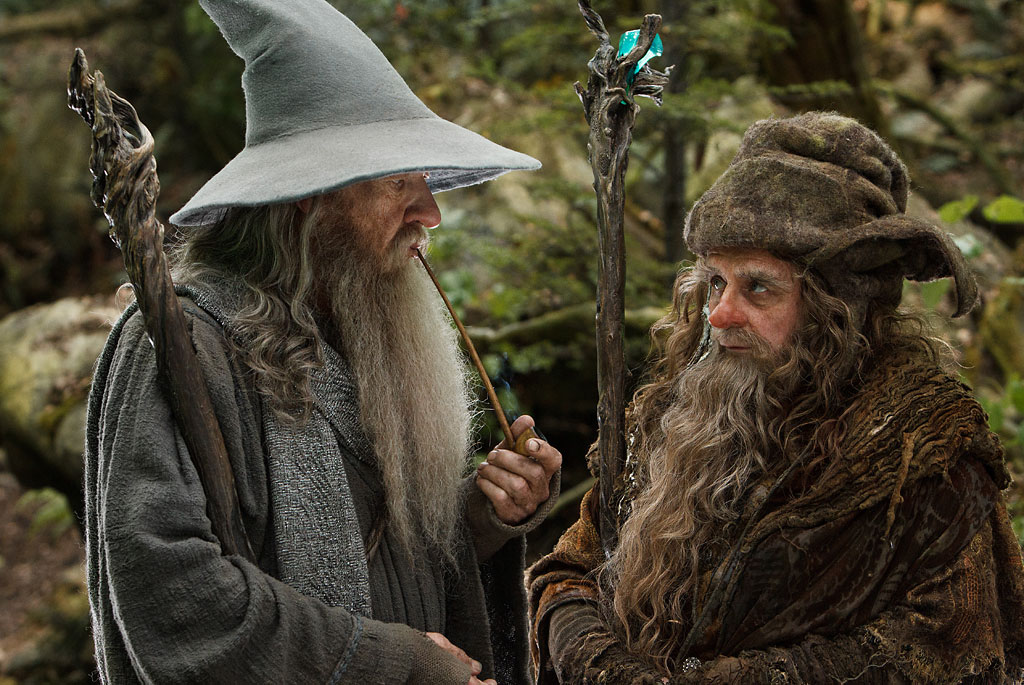
Radagast the Brown!
I've already watched this movie thrice - 2D, 3D and 3D Imax. Just bloody go watch it.
I have this theory I like to call the "Friendship is Overrated" theory. Essentially, it's an anecdotal type theory where I posit that people whom we used to call friends, close friends even, are no longer our friends. At the time that we were close, we felt that they would always be close. But as we all know, people evolve, not necessarily on similar paths and so, for whatever reason, we don't talk anymore. Organically, but still. And so, if we were, at time T, willing to bet that a given friend V would always be our close friend, but at time T+a, where a>0, V is no longer our friend, what does that say?
Assuming that the friendship faded off organically, the implications that come to my mind are as follows. Firstly, neither of us are 'bad' friends. Secondly, at least one of us evolved in ways in which the other person no longer brought utility to the other. Otherwise,there would be ongoing reciprocity in the friendship. [Note: Let's not pretend that we're friends out of some selfless benevolence. We're friends because you give me utility (satisfaction) when you hang out with me and I give you utility when I hang out with you.] Thirdly, if I thought you were so important then, but are no longer important now, then that implies all friendships (or all relationships) are transient. This means that I overrated your importance to me - I thought I would want you as my friend for a long time, but it turns out, I don't. And so, even our closest friendships can be transient, and just by extending the logic a little, overrated.
Anyway, this chain of reasoning is all well and good, fairly straightforward. What's more interesting is why do we overrate friendships? Or, maybe a bit more simply, why do we feel that our close friends will always be close to us at any given point, but as it turns out, they won't be some time in the future? I think an important reason to consider in answering this question is that people tend to think of themselves and their friends as constants.
We live with ourselves every day. And every day, we evolve one way or another, incrementally. The thing is, with incremental changes daily, we hardly notice them. It's kind of like how if you see a person day after day, you may not notice right away that they're actually getting taller or whatever but if you see a person maybe one year apart or so, the change is a lot more obvious. I think the same is true of personalities. Unless something super drastic happens or some form of mental illness, I don't think someone transforms from mellow to hyperactive in a day or from lazy to hardworking or from a friend who gives us satisfaction to a friend who doesn't. The binary-ness of it rarely ever happens. But all this implies is that we're not constants. Yes, we may have some of the same traits as we did before, but to think that we're the same person from a year or two back is rather preposterous. I find it difficult to believe that anybody can have no new experiences between, say, the 1st of January 2012 and the 1st of January 2013.
And so, if we're not constants, how can we expect our decisionmaking to also be constant? For example, if going drinking was my standard response to a long day back in 2009, will it always be my standard response? I doubt it. If at one point I chose to not cheat on an exam, will I always not cheat on an exam? Can't guarantee it. I think it's in rather poor form to say things like, "I'll always choose X over Y" or "I would never make that decision." Sure, you would choose X over Y NOW, or never make a given decision NOW, but should you really hold your future self to this? Let's be clear, assuming you live at least another 20 years or so, the You in 20 years time will be a different person to the You now. This is across time. If we control for time, and bring the You in 20 years time to present day, you'd be two different people. And so it should be treated. What I want now more than anything else may not be even be on Future Me's list of wants. When we make promises, or when we say things that include the term "ever" or "never" or that sort of thing, we are actually holding our future selves to it, not ourselves.
But all this is rather clear cut. I don't think anybody believes that we don't evolve. But when we make decisions, we seem to treat ourselves as constants, despite knowing that we do change or that our friends change. So, how then should we treat our decision making?
I read it about a week ago and have been meaning to write about it. It's quite interesting and, I think, fairly novel. It brings a neat change to our beliefs that our decisionmaking is constant. Let's mathematicize this thing.
If it was true that our decisionmaking was constant, i.e. we don't actually ever evolve, the function would be something like:-
Utility = Max(D1, D2, D3....Dn), where D represents the decision which will maximize our utility.
But if people are response functions, meaning they respond differently based on different permutations of themselves whether across time or across space, the function would then look something like:-
Utility = Max(D1, D2, D3...Dn | Ti, Sj), where T represents the Time we're in and S represents the Space we're in, i and j are both elements of a set of all times I and a set of all times J respectively.
Essentially, the functions says, the utility-maximizing decision depends on which Time we're in and which Space we're in. For example, if I had been born in, say, Kuala Krai versus being born in Kuala Lumpur, I would probably have evolved differently. I certainly wouldn't be who I am now, for better or for worse. My decision making is therefore responding, albeit not consciously, to the Space in which I was born. Likewise, if you catch me on a bad day (Tuesday - I fricking hate Tuesdays), my decision to be pleasant to you or to be sarcastic as holy hell toyou may differ. My decision making is responding to the Time in which we find ourselves. I would be remiss to believe that I would make the same decision if I were born in Kuala Krai or Kuala Lumpur and I would be remiss to believe that I would make the same decision if it were a Tuesday or a Friday.
This is not to say we should never commit to anything. Or that it gives us an excuse to break our commitments. I do believe that if we commit to something, we should try our best to see it through. Otherwise, don't commit. But, at the same time, it does help in understanding the decisions we make and the decisions that others make. For example, if person V chooses not to contact me anymore, or that we fell out of touch, it's probably because I no longer give person V utility in the current Space and Time. Which is fair. Nothing personal. More importantly, it should make us cognizant (am trying to re-phase in American English) of the notion not to blame other people for changing because, hey, we changed too. "You've changed, I can't relate to you anymore" is probably one of the most illogical accusations people can throw.Just remember, people aren't constants, and since you're people, you aren't a constant either. We're all really just a processor of response functions.
I was out for dinner today at this coffee shop place in Sea Park. And by coffee shop, I mean like the hawker center type of place, not the Old Town White Coffee or Poppa Rich type places. I would put a picture of the place and the food, but hey, I'm utterly useless as a food blogger, remember? But anyway, there's a stall there that sells a particular type of Penang food. That's not the interesting bit - seems like every fricking stall has the word 'Penang' in it. Penang Char Kuay Teow. Penang Curry Mee. Penang Assam Laksa. Penang Mi Goreng. Whatever. But the thing that fascinates me about this particular stall is the lady who runs it.
The next paragraph is what went through my head as I observed her:-
"At a guess, she's maybe 65-70 years old, perhaps older. Or maybe she's younger but looks older because she's had a rough life. Has she had a rough life? I don't know. I wonder. I wonder how she comes to the place every day and how she goes home. Surely she walks. She doesn't strike me as someone who would have a car. Maybe a relative drops her off. Does she have relatives? Maybe someone else who works here drives her to work and back every day. Where does she live? Is she happy? She looks, for lack of a better word, very feeble. She walks very slowly. She has a badly hunched back. What type of life must she have led? I wonder how she feels about her life. Does she feel lonely? She must feel lonely. Who does she talk to? Does she have friends? How did she end up in such a state? Isn't it rather sad that her life has led her to this point simply because, for whatever reason, she didn't end up in a wealthy family or with a family, in the first place, assuming she doesn't have a family. And on her stall, she has a newspaper clipping by some Chinese newspaper with an article about her stall on it, coupled with a picture of her. Is her stall really that good? Or did some reporter feel sorry for her, seeing her in her feeble state, and decide to promote her stall in hopes that she would get more customers, and thus more income? The clipping is also laminated which means that, at one point in her life, she was proud of that clipping. Is she still proud of it? What's her life story?"
I shit you not, I actually thought of all those things when I was observing her bringing food here and there to customers at the coffee shop. Which made me think, life is fricking arbitrary. It is for everyone. We really did not choose to be born. We have no control over who our parents are. I don't believe in souls or reincarnation or that kind of thing, but seriously, if you believe in souls, then it does stand to reason that every soul has an equal opportunity of being born to any given family no? Taking spiritualism out of it, every individual in the world came into existence entirely arbitrarily. I could have been born the son of a miner in Chile, or the son of the King of Spain or whatever.
While, yes, it doesn't really matter how arbitrary this is, simply because this is just one of the things we have to just deal with - we can't change anything nor do we have any control in the first place - the consequences of this arbitrariness matters. I'm quite frankly too lazy to go trawl the interwebs for empirical evidence that a person's background affects their future, but I strongly believe it does. And, I also don't believe that all humans are born with a blank slate or, in other words, a consciousness that is like a blank piece of paper that just needs to be written on. I believe that genetics matters. In nurture versus nature, I don't believe that a person is who they are simply because of nurture or simply because of nature. I think the answer, like most things in life, is somewhere in between.
BUT, that said, either nurture or nature, how a human develops then is pretty arbitrary. If I was born, because of recessive genes, color blind or more susceptible to diabetes, that's just my fortune, or lack thereof. If I was nurtured by irresponsible parents or by apathetic teachers, what can I really do as a child who doesn't know any better?
And so, yes, existence is pretty fricking arbitrary. That's no real surprise and not a difficult conclusion to draw, unless you believe that everything's fated or scripted by some higher power or something. That's fine too. But of course, I don't believe in that line of thought. A better question is simply, is it fair that existence is arbitrary?
Well, from a purely statistical standpoint, and this is actually some pretty mind-boggling reasoning, every individual theoretically had just as good a chance as the other of being born to the parents of one another. I find it difficult to wrap my head around this because, well, if there was no 'me' before I came into being, how the hell could probabilities be assigned equally to 'me'? But anyway, I could have just as easily been the child of Michael Jordan (in which case, life is awesome) or I could have just as easily been the child of a serial child abuser (in which case, life sucks). But since every individual has the same odds, isn't it fair? Doesn't life treat everyone indifferently then? The universe is indifferent, as Don Draper has said before. And if the universe is indifferent to everyone, then how can it be unfair? I just wound up with better luck than a lot of others and worse luck than some others.
But if I recognise that my station in life arose because of completely arbitrary matters (for example, being born to parents who recognised the importance of being outspoken), then shouldn't I also recognise that the stations in life of other individuals also arose because of completely arbitrary matters? For the sake of consistency, absolutely. But if I know that sometimes, where they are in life wasn't a result of their poor choices or their mistakes, say, that old lady in the coffee shop (assuming she didn't make a series of poor life decisions), then shouldn't I try to remedy this inequality in fortune?
I don't necessarily think, and in fairness I haven't thought this out through and through, that I should be obliged to equalise this arbitrariness. Of course, it's easy to say when I'm on the rock and roll side of the arbitrariness coin. I may believe differently if I were on the other side of the coin. This is where moral reasoning should come in handy. From a more libertarian perspective, I don't think I should be morally compelled to equalise this arbitrariness. But this gives me an uneasy feeling. After all, if I want to get ahead in life, I want to do it because I worked harder or I'm more skilled or that sort of thing. I don't want to get ahead by virtue of having more opportunities than others. I want to beat people who have had the exact same opportunies I had.
At the basic level, I suppose it comes down to making sure that the starting line for everyone in the race is the same. But what if I was born fully healthy and I was racing against someone who was born without a right leg? Is it really fair to argue that, "Hey, that's just the breaks. That could have easily been me. But it's not. So, let it be."? I don't really know but my initial thoughts are that it's unfair. So what would make it fair? Well, for one, what would NOT be fair would be amputating my right leg to bring me 'down' to a fairer fight. Personally, I think that's completely morally objectionable. I should not be penalised just because I have an advantage. But I do think the converse is the way to go. Don't penalise me but help the other person by giving that person a prosthetic leg or something. Then let's race from there. I think I'm comfortable with that.
To be honest, I didn't really have a conclusion I wanted to draw when I first began writing all this. That's why it's labeled 'Ramblings'. But I do want to make the point that seriously, existence is fricking arbitrary. Like Rorshach says, "Existence is random. Has no pattern save what we imagine after staring at it for too long. No meaning save what we choose to impose." He goes on to describe the non-existence of God but that's not what I'm trying to get at. But maybe, if I were to draw one conclusion, it would be that, if we believe that existence is arbitrary, and that we are all not tied to destinies or fates by some higher order puppet-master, then the moral reasoning employed on the perspective of existence is vastly different from moral reasoning employed on an existence with predetermination. I don't really know what sort of reasoning would go into figuring out this whole arbitrariness thing, but I think it would be worth a good try.
While I am not really one to follow weekly releases of comic books, as evidenced by my preference to wait for the New 52 Graphic Novels - Detective Comics, Action Comics, Justice League of America etc - rather than collect each individual issue, I have been trying quite hard to seek out the Before Watchmen miniseries by individual issue. I'm not certain why; after all, I just have to wait a bit for the Graphic Novel to come out, encapsulating all the various issues into one easy, convenient book.
The Before Watchmen miniseries capture the events in the lives of the Watchmen before they became, well, the Watchmen. The series includes Minutemen, Nite Owl, Rorshach, Silk Spectre, Dr Manhattan, The Comedian and, my 14th favourite male character of all time, Ozymandias.
Ozymandias, King of Kings
Of the entire miniseries, I have chosen to follow Rorshach, The Comedian, Dr Manhattan (quite psychadelic to be fair) and, of course, Ozymandias. And I gotta say, tracing how Adrian Veidt became Ozymandias is seriously compelling and, dare I say, inspiring. Especially, of course, if you're a megalomaniac.
I've always thought a superhero or an idol, for lack of a better word, should not really be someone you can relate to, but rather someone you can strive towards. For this reason, while I can understand why people tend to like, say, Spiderman or Batman or, maybe, Wolverine, I'm not convinced that they make good 'idols', necessarily. It's kind of the same logic when building, say, a company. Would it be better to build a company based on pragmatism or a company based on ideals? I can take the pragmatism point, but I strongly advocate ideals, simply because ideals are things behind which people can rally. But I digress.
Adrian Veidt's journey and eventual Watchmen-defining moment make for a nice twist because Adrian Veidt makes for an antagonist who is kind of an idol of mine. I mean, he's called, in the comics, as the "smartest man on the planet." Doesn't take Sherlock Holmes to see why that would be appealing to me. But the way in which he became Ozymandias or, at least, his journey in the first 2 (of 6) issues of the Ozymandias Before Watchmen series is incredibly fascinating. I'm not going to give a synopsis of the events because I seriously think you should read it, but I really love the way in which he became an idol of sorts - He chose to measure himself against his idol.
I don't think I'm being very eloquent here, but essentially, I find it really fascinating how he became an idol (of mine, at least) because he wanted to be like his idol. And, unlike 99% of the human population, he actually achieved the successes of his idol. I mean, most of us, we want to be like MLK, we want to be like Lincoln, we want to be like Mandela, we want to be like Gandhi. But we never get to be simply because, well, we fall short of them. But there's nothing wrong with striving to be like them. And that's the difference between us and Adrian Veidt. He did not fall short.
In Before Watchmen, he describes how his mind was battling with the following questions - Firstly, how had someone so young (Alexander the Great) come so close to uniting such an ancient, primitive world? And secondly, how did one man drag a civilization barehanded from the blood and filth of such utter barbarity? Taking it upon himself to match Alexander, he chose to measure his own success against the success of Alexander, setting himself on his life path. He wanted to bring an age of illumination to a benighted world. He adds though, and this is an amazing line - one which actually gave me goose bumps and blew my fricking mind, "In truth, I think I just wanted to be able to have something to say to (Alexander), should we ever meet in the Hall of Legends."
Wow.
I mean, wow.
Of course, as the story goes, while he traced the life of Alexander, Veidt found disappointment in his idol as he found that Alexander had not united all the world, nor built a unity that would survive him. This, of course, despite Alexander reportedly weeping when he found out that there were no worlds left to concur. Instead, on a hashish-induced night, Veidt finally found his calling. He had finally found Alexander's true triumph. Alexander has merely resurrected an age of pharaohs, whose wisdom was truly immortal and was now the source of inspiration for Veidt. And, in time, he took the name Ozymandias, the Greek version of Ramesses II, the greatest Egyptian pharaoh of all time.
Anyway, so that's how Veidt became Ozymandias. But the next step was to find a way to become immortal, to match the achievements of Alexander and Ramesses II, to bring an age of illumination to a benighted world. He needed to find his way into the Hall of Legends. You know how the story goes. If you don't, shame on you. Realising that merely fighting crime and evil villains only helped symptoms of the human condition, he strived instead to alter the human condition, attempting to alter human nature rather than simply applying bandaids in spaces where the negative side of human nature chose to manifest itself. He realised that no amount of beating up villains would really alter human nature. It was no way to join the Hall of Legends. The Smartest Man on the Planet had, in fact, been slow to catch up to a fact fully understood by The Comedian earlier, which was that mankind has been trying to kill each other off since the beginning of time.
Once he understood that, Ozymandias crafted the biggest trick in human history. Essentially, his method was this - realising that, throughout human history, humans have found other humans to be their enemy; there was no common enemy to unite everybody. In essence, that has been true of most wars in history - people uniting against a common enemy. I mean, consider World War 2. 2 countries which would enter into a Cold War and, really, had no real reason to be allies found themselves on the same side against a common enemy - the Nazis. That's what unites people. The presence of the 'other' against which everyone rallies.
Ozymandias gave everyone that 'other' by killing millions to save billions, ending the Cold War (which was threatening to erupt in nuclear war between the aforementioned 2 countries). Rather than stopping the present symptom (the Cold War) as he knew more wars would come even if he achieved peace negotiations or whatever, he chose to alter human nature, giving humanity a new 'other' in which to unite against.
Now, I'm all for the greater good and all that but I do have my moral reasoning objections against what Ozymandias did which made him the antagonist of Watchmen. But using a rather Bentham-ic Utilitarian kind of world view, he chose to sacrifice millions to save billions. A completely out-of-the-box unorthodox method to really unite the world. And that's what happened. He succeeeded (at least until the end of the novel - we don't know events that transpired after the New Frontiersman found Rorshach's journal). Whether or not he brought an age of illumination to a benighted world, he united the world. He united humanity by giving it a new common enemy.
Ozymandias may have had his methodology completely screwed up, but y'know, I completely buy the original idea that he had. I don't condone the execution of the idea nor would I have done it but I think he was right. If you want to change human nature or at least trick human nature, give a common enemy. This has ALWAYS worked in the past. Think of Americans uniting against Communists or Malaysians uniting against the British for independence or that sort of thing. This works. You can't keep on dealing with each human versus human problem one by one and expect it to be sustainable. But giving all of humanity a new common enemy? That is fricking brilliant. Give the man credit - he measured up to the successes of his idol, becoming an idol himself despite being a villain and should he have met Alexander or Ramesses II in the Hall of Legends, he would have had something to say. And they would have looked upon his works and have despaired.
When Lebron James announced on ESPN (hint: National TV) in 2010 that he was leaving the Cleveland Cavaliers to join the Miami Heat, like many others, I was disappointed. Maybe I wasn't as angry as the real Cleveland fans; certainly, I cannot begin to understand the vitriol that they were facing. Here was the one bright spot (and a huge bright spot too), one of the best (at least) 20 players of all-time and potentially even higher, a hometown hero (born and raised in nearby Akron), the guy who made your perennially crappy team relevant again. Essentially, with Lebron James in your team, your team was a contender for the NBA Championship every year.
So, when he bolted for Miami in Summer 2010, I thought, like many others, that it was a copout on Lebron's behalf. Yes, I also understood that Cleveland fans would feel a whole range of other emotions, but given that I am both emotionally stunted and I wasn't from Cleveland nor a Cleveland Cavaliers fan, I could not tap into that range of emotions. So, why was it a copout? Well, I thought, damn, if Lebron wins a championship for Cleveland, he becomes immortal. He will be loved forever and ever, a hero in the eyes of the city of Cleveland and probably even the entire state of Ohio. That's quite a legacy to have. And so, yes, I thought he tarnished his legacy there. I held on to the rather strange belief that you should want to beat your competitors, never to join them when, really, all Lebron was doing was giving himself a better chance to win an NBA Championship.
Then, when the Heat lost to the Mavericks in the 2011 NBA Finals with Lebron suffering from a sort of inexplicable meltdown, I felt like good had triumphed over evil. And I felt smug. "Take that Lebron". For some reason, I rejoiced in the downfall of Lebron James.
We all know (or at least those of us who follow basketball somewhat) what happened the following season. Lebron had probably his best season ever, morphed into "I-can-do-whatever-I-want-on-the-basketball-court-and-there's-nothing-anyone-can-do-to-stop-me" shape and obliterated all comers. I watched a LOT of the NBA Playoffs, particularly because my Boston Celtics made it to the Conference Finals with a legit chance (2 match points, actually) to make the Finals, getting Lebron-ed in the process (Game 6) by the Miami Heat. The Heat went on to win the Finals by 4 games to 1 (re: fairly handily) and Lebron was magnificent. He put on a basketball display of the highest order, both on offense and on defense. It was like watching basketball played at the highest possible plane.
So, compare June 2012 with July 2010. How would I think in July 2010, knowing what would have happened in June 2012. Granted, I'm a douche, so I think my response would still have been, "Yes, but he still jumped to Dwyane Wade's team." When, really, the appropriate response should have been, "OMG, he finally manifested his destiny. The rest of the league is screwed." All his legacy is going to read is "NBA Champion 2012, NBA MVP 2012, NBA Finals MVP 2012 - Played an all-time great series in NBA Finals 2012." Why should it matter whether he did it at Cleveland or at Miami? Who am I to say what his legacy should or shouldn't be? All Lebron will care about is what he achieved.
He has openly admitted that he regretted the manner in which he announced his Decision to leave Cleveland. But, should he get skewered so much from moving from Cleveland to Miami? See, in sports, we as fans hold such bullshit double standards that it insults all of us collectively. In the non-sports world, we all would
a) Rather work with colleagues who we knew were at the top of the game if we wanted to succeed
b) Get higher pay from a rival company even if it was a rival company (Lebron took a paycut btw)
c) Listen to whoever our closest advisers were - family, friends etc
d) Focus on our achievements without caring what arbitrary people would think about us
Instead, Lebron got skewered for each of those points (bar point 'b' because he took a paycut). It's bullshit. We, think, as fans that we would ALWAYS be loyal to our team, we would ALWAYS put the needs of the fans before our own needs (because we care about the team and all) and we would ALWAYS be willing to stay for lower wages in our own team rather than take higher wages for a rival team (see: Carlos Tevez, any ex-Arsenal player who jumped ship to Man City). But, in real life, when it comes to our own jobs, we don't mind switching if we're getting a significant pay rise. We don't mind switching to join a better company with better people. We don't really care what our current company may think if the move makes a ton of sense for us. So, why should Lebron be treated any differently? Should he be what WE want him to be?
Check out this amazing commercial, released in June 2010. Back when it was released, I didn't get what it was trying to say. I thought it was just Lebron being defensive and trying to make excuses. But looking back (like half an hour ago), I think there's a subtle message to it that is really rather brilliant. Give it a watch.
The messaging is brilliant. I think it is saying, "I'm just like any of you. So why should I live up to your expectations when I don't hold you to mine? Should I be who you want me to be or should I just go be who I want me to be?"