In my "Entertainment" folder on my computer, I have a folder called "Movies." In this folder, there are 110 movies. These are all movies that I've watched before and are all movies that I think are worth keeping on hand just in case the mood strikes me and I want to re-watch them or in case I want to re-watch specific scenes from them. Of these movies, I have a sizable collection of "Teen" movies too. Way back from the first movie I ever watched with my friends in a cinema - the classic "10 Things I Hate About You" - to the more recent "21 Jump Street" - where Brie Larson steals my heart and gets punched in the boob - to "Superbad" with the scene-stealing McLovin to the totally fetch "Mean Girls" to the all-time super-provoking "Breakfast Club" with a Brain, a Princess, a Basket Case, an Athlete and a Criminal, I do have an affinity for teenage movies.
Within the realm of "teenage" movies, there are different types of teenage movies as well. There's the more stoner type like "Dude, Where's My Car?". There's also the quintessential teen movie, "10 Things I Hate About You" (I say quintessential because there are many such examples as this movie - Can't Hardly Wait, Never Been Kissed, She's All That etc - where the plot is generally based on the same formula but only just varies slightly). Then there's the more smartly written stuff like "Mean Girls", "Superbad" and "Easy A" which are quite clever and have a different type of angle to it while retaining the general "teen" spirit of teenage movies. I think this is particularly true of "Superbad" which I think is the most tender of the lot. Also, having Emma Stone doesn't bloody hurt.
But, after having recently watched two teenage movies, I was led to the conclusion that I am particularly fond of "teenage" movies for two reasons. First, I am old and these movies tend to make me nostalgic. Take "Nick and Norah's Infinite Playlist" where Kat Dennings first appears on my, "Good God, I love this woman" radar. In the movie, Nick and Norah basically spend the entire time gallavanting around New York City till the late, late night. Watching the movie, at the first time, made me sad because I think it's a sort of cool youth/innocence thing that only really exists when you're 17 or 18. I think, as you get older, you get over that kind of stuff so that it becomes very mundane. Nights out until 6am can still be super fun at 25 or 26, but they don't have the same wonder and magic as nights out until 6am when you're 17 or 18. So, yes, I do kind of miss the wonder of being 17 or 18.
Second, I love character development in stories. I will automatically dismiss a story as being rather crappy (despite great acting, despite great CGI, despite great cinematography, despite great locations, despite whatever) if characters are not being developed meaningfully in movies. For example, I don't consider Captain Kirk in the two most recent Star Trek movies as a character whose character was developed meaningfully throughout the movies. For one, we used two movies to hash out the same plot - Rash but brave young officer learns from his mistakes (which arose through his hot-headedness) to lead everyone to victory and grows up in the process. For two, it's just too easy. I don't believe that people switch 180 degrees just like that in personality. If you're going to develop a character, do it properly. Go each step of the way.
Anyway, when you're a teenager, lots of shit happens to you that develops your personality. This is true in stories and in real life (not necessarily mutually exclusive). So, it is natural that teenage movies are sort of a natural habitat for coming-of-age stories, which are, to me, the best types of character development. Sure, you can have great character development like the rise and fall of Michael Corleone in the Godfather series (another top, top favorite) or like the evolution of Christian Bale's Bruce Wayne in the Batman Trilogy or, in books, Jack Torrance in The Shining and other such non-teenage examples.
The difference is that the teenage stories have that extra sweetness about them simply because they remind us, or me at least, of a time that once was - a time of a great deal of innocence and honest mistakes. And so, I am especially fond of teenage movies that explore this character development of the age where we are the most malleable, and the most easily influenced by a shit load of factors. The great thing is, we can all relate as well since we've been through that stage of life. We know how a lot of things feel like and we feel that they are super poignant to us. Maybe we will never ever know how it feels to have our character corrupt slowly like Michael Corleone (I highly doubt anybody I know will be a serious Mob boss) or to have the character evolution of fricking Batman, but we sure as hell can know how it feels like to want desperately to fit in somewhere, to feel as if a boy's love or a girl's love is the only thing in the world that matters or how it feels like to be unfairly suspected for things just because we've made mistakes in the past. We know all that.
And I think we therefore can identify quite strongly with movies that show us just that. Those that really make those feelings come 'real'. Those that show rather ordinary characters in rather ordinary lives but trying their damned best to face ordinary issues. The movies that do these best are those that tell the stories patiently without skipping steps. They explain why characters make the decisions they do, what events force incremental personality changes in characters. That sort of stuff. And so, if you haven't gotten my point yet, you're in for a treat.
Rather than making my point shorter and summarizing it, I am going to beat my point down via the lens of my 5 favorite coming-of-age teenage movies, ranked of course. To put all cards on the table, I was okay with "The Perks of Being a Wallflower" too, but in that movie, Charlie got to kiss Sam (played by Emma Watson) and grope her too. So, now, that movie just brings back horrible memories for me.
5. The Way, Way Back

Issues Confronted: Mom re-marrying a tool, step-sister who thinks he's a complete loser, almost complete lack of social skills, constantly feeling like a wallflower and feeling anonymous.
Why It's Poignant: For the most part (except maybe the family bits), describes nearly every teenager ever, with the exception of the cool kids. Sometimes, we just need to find a place where we're appreciated and where there's someone who just accepts us for who we are and we can find our place. Look, being 14 and a loner is kinda crappy, especially if your (step) sister is a popular kid who doesn't want to be seen with you. You're now forced on a 'family' vacation with no friends and it's hard for you to make friends cos you don't have adequate social skills. How the hell are you going to grow that way?
Look, maybe I didn't really have this problem. But I know tons of people who did. And it's very real. I'm sure we can all think of that one kid at school who kept to herself all the time or just to one friend all the time and never really fit in anywhere. How would a person like that discover herself? How would she gain confidence? How would she feel appreciated?
The Way, Way Back tells this story exceptionally well. [Because this movie is new, I am not going to say anything about the ending]
4. The Breakfast Club
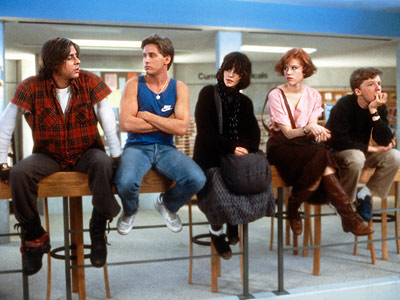
Issues Confronted: Stereotyping in high school, the need to feel like you belong, dealing with people of other 'stereotypes' that you're not comfortable with, "What happens next?"
Why It's Poignant: Okay, this shit is true for nearly every teenager. When I was in Form 2, the first year classes were streamed, I was put in a class with students who were perceived as the largest nerds/geeks in school. For whatever reason, I wasn't (yet) included in this group. One of my classmates who was placed in this class actually said to me, "We need to get out of this class. It's like the Malay saying, [translated] if you enter a chicken coop, you'll come out smelling like chickens." Then, I thought, "Wait, I'm not a nerd? Sweet!" [NB: I have later on fully embraced my nerd-ness]
Now, this person who made this comment was a Scout. And believe me, there were stereotypes of these people as well. Was this fair? Of course not. Did we care? Of course not. All we knew was that there were the Cool Stereotypes and there were the Uncool Stereotypes. And we didn't want to be in the latter. Did we care that we were all idiots and roughly the same anyway? Of course not! We thought we were completely different. This movie felt real to me for that reason. It explored how different stereotypes respond to one another in a closed setting (detention on a Saturday morning) and how these different stereotypes found that they were really not that different after all. They smoked weed, they danced, they learned about each other, sparks flew. And then, detention ended. And they left. We don't know what happened after.
 |
| Well, we know this happened. |
Now, if were were to do an epilogue to this, how would it go? I'd like to quote Cracked on an epilogue for this movie:-
"Did they remain friends when they went back to school on Monday? Or did they immediately return to their respective social circles and continue ignoring each other? The Brain character, Brian, actually raises this point in the movie when he accosts the rest of the group because he assumes they'll go back to ignoring him when school starts up on Monday. Was he right, or did everyone change? This is important to me, because it can turn The Breakfast Club into either an amazing movie or a shitty movie.
If the kids show up to school on Monday and form a new clique that breaks down social barriers and challenges conventional high school's idea of archetypes and popularity hierarchies, that makes The Breakfast Club a piece of shit movie. If the Jock and the Brain become best friends and the Criminal and Princess start a relationship and have a family and a million babies, we'd lose the realism and honesty that was present throughout all of The Breakfast Club's non-weed-related moments. The Breakfast Club was great because it was just a slightly heightened version of reality. Throwing in a big huge happy ending makes The Breakfast Club a cartoon.
The right ending would have the kids all going back to their own cliques, because that's how you survive high school. The Criminal goes back to being high and making fun of the Brain, the Princess goes back to ignoring everyone, and the Jock continues doing whatever popular Jocks to in high school (probably some cool, outside-the-box sex act that I still know nothing about). That ending makes The Breakfast Club heartbreaking and real and kind of a perfect movie."
Erm, yeah. Exactly whatever they said.
3. Stand By Me
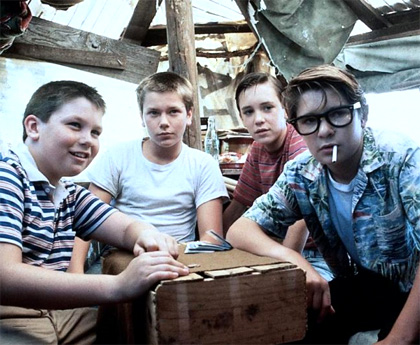
Issues Confronted: Family problems (abusive alcoholic father), Bullies, Oppression by adults, Unfairly victimized because of family reputations, What it means to be more than friends
Why It's Poignant: If I was a kid again, and I knew there was a dead corpse somewhere I could hike to, abso-fucking-lutely I would go look for it. It's an adventure, in a more 'realistic' fashion. Even now, if there was a corpse somewhere, I would do it. So, there's that part.
But here's the other part - why this movie just fricking takes a sledgehammer to your heart. These kids all have issues, serious adult issues but the problem is, they're stuck where they are because adults use these issues against them. One of the characters gets blamed for stealing money from the school cafeteria just because his father and his brother have terrible reputations when, in fact, it was the cook herself who stole the money. But no one believes him. He is saddled with a reputation he does not deserve for seriously arbitrary reasons. Twisting this a little, can you imagine yourself gaining some sort of reputation for whatever by virtue of making a dumb mistake when you were a kid or by virtue of hanging out with a particular friend?
The best part of this movie is how serious the conversations between the boys get as they go along when they explore each other's issues and learn how effing difficult it is to be each other. Look, we all have the tendency to believe that our lives are the hardest, and it may very well be, but I also think we lack the capacity to be honest about how hard our lives actually are. I think we hide many, many demons under the surface despite all these demons keeping us Up All Night (sorry, had to include a Blink 182 reference here - was feeling it). And the acting by the child actors is top-notch; the depth of sincerity and honesty in which they discuss their experiences.
And also, in the epilogue of this story in the book (Stephen King's "The Body"), the main narrator states that they drift apart after a while, as friends are wont to do (we all have been through this) and he tells of what happens to the kids in the coming years. He ends with this line, "I never had friends later on like the ones I had when I was twelve. Jesus, does anyone?"
I had to have a moment when I read that line and when the narrator says it at the end of the movie. Because it's bloody true. I will meet people throughout my life and some of these people will end up being close to me. But, you can't really ever replicate the connection you had with the people with whom you were close when you were going through puberty. People with whom you grew up. Because those are the formative years of your life and those people, more than anyone, formed who you are. It's like Cartman says in "Casa Bonita":-
"I know we argue all the time and I give you tons of crap but we also have been through a lot together. And maybe that alone doesn't make us friends, but that makes us something."
You cannot ever replicate that something. And so, for me, I never had friends later on like the ones I had when I was thirteen. Jesus, does anyone?
2. October Sky
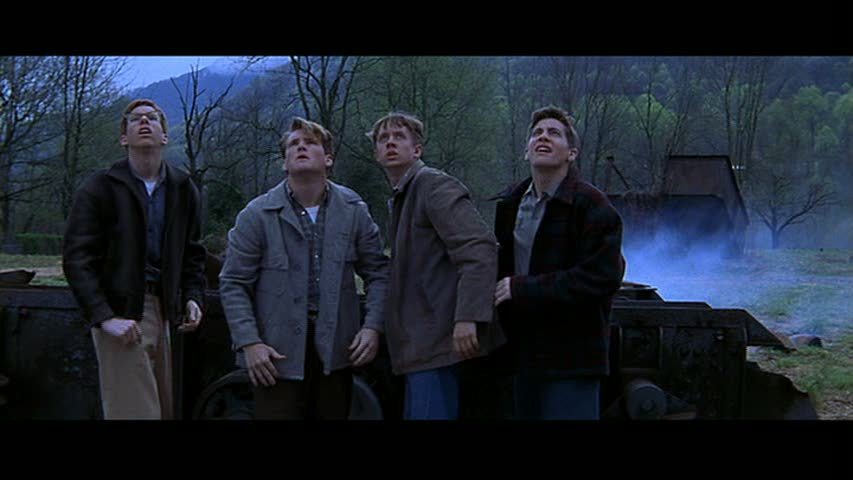
Issues Confronted: Covered here.
Why It's Poignant: Covered as well, so I shall do a two sentence summary. First, this movie is a rarity in the sense that it has a fairly happy ending (which fit!); most of the movies I like tend to have more realistic endings (as I think happy endings for everyone are very unrealistic). Second, this movie can remind us of our triumphs, despite opposition from many and the support of only a few and how it only really takes one person or one event to truly inspire us.
1. Dead Poet's Society
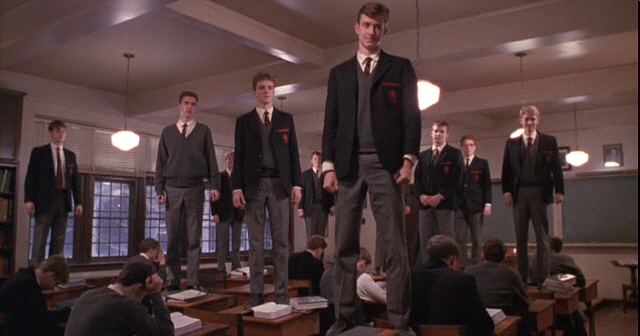
Issues Confronted: Covered here.
Why It's Poignant: Again, a two sentence summary. First, the main character in this movie (to me) is Todd Anderson, as he is the only one with serious character development in the movie. Second, I think we can all relate to the feeling of having our parents control our lives (as teenagers) and feeling completely helpless by it all with no escape clause as the establishment (in this case, the school) obviously takes the parents' side, and all we can do is show our loyalty and support to our cause without really being able to change anything.
So, there you have it - my favorite coming-of-age teenage movies. I think if you notice the themes, you'll note that the reason I treasure these movies so much is because they feel real. Like they could actually happen to people we know. I think October Sky and Dead Poet's Society may have their sense of reality heightened just a tad but, in general, I think many of us can relate still. I personally believe The Way, Way Back, The Breakfast Club and Stand By Me are almost as real as it gets, and that's why they're so heartfelt. Because we can identify with those kids in the movie who we can see as ourselves. And like Stephen King says, maybe those children we once were weren't the best version of ourselves, but they were the repository of all we could become. And to think that we went all through that, and the friends we shared those experiences with, it makes this genre especially poignant.
There's a movie coming out soon which I believe will add to this sense of nostalgia, innocence and, dare-I-say-it, love. Here's the trailer for "The Spectacular Now." Do yourself a favor and watch the trailer, and then watch the movie.
No comments:
Post a Comment